The challenge
Poker knowledge and poker judgment are related, but they are not the same skill. A player may know every hand ranking and still enter too many pots from early position, call because a hand once looked promising, or continue simply because chips have already been invested. The rules explain what actions are legal; judgment determines which action makes sense now.
Look beyond the obvious
Many costly mistakes are not caused by ignorance of one isolated rule. They happen because a player overlooks the condition that should guide the decision. A hand that is playable on the button may be troublesome under the gun. A pair that was strong on the flop may be vulnerable after a coordinated turn card. A call that looks inexpensive in isolation may become a major commitment relative to the pot and stack.
A more disciplined approach
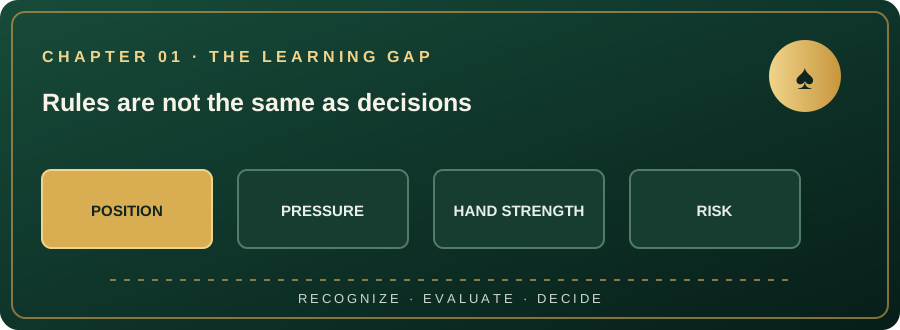
Improvement begins with diagnosis. Instead of saying, “I played badly,” ask what made the decision difficult. Was it position, pressure, hand strength, or risk? Naming the obstacle gives you a practical way to review the hand and choose a better response next time.
Put the idea into practice
Review one recent hand without judging the result first. Write down the decision, the information available at that moment, and the obstacle that mattered most. Then ask whether you would make the same decision if you could replay the hand with the same information.
Identify the obstacle, evaluate the situation with the information available, and choose a deliberate response rather than reacting automatically.
Watch Video 1: Why Players Struggle to Succeed at Hold’em
If the video does not load, watch Video 1 on YouTube.
Ready for the complete book?
This online edition introduces the framework and selected ideas. The complete book develops the concepts in greater depth.
Buy the Complete Book on Amazon