The challenge
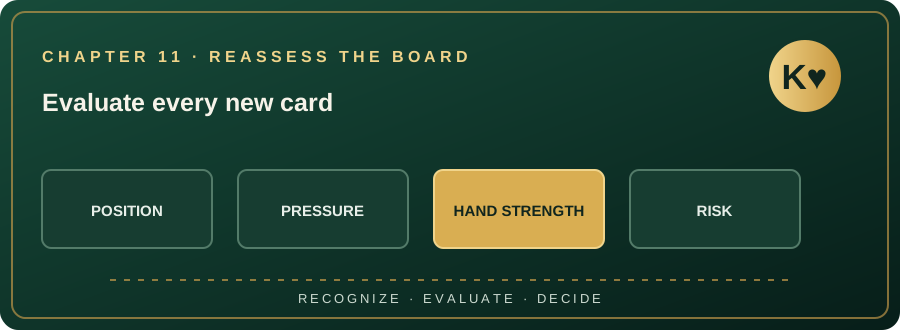
Evaluate your hand in relation to the board and the opponents who remain. Ask what worse hands might continue, what better hands are possible, and which draws are available. This is more useful than simply naming your hand category.
Look beyond the obvious
Reassess on every street. The flop may give you top pair, but a turn card can complete a straight or flush draw. A river card may change which hands are plausible. If the action becomes unusually strong, consider whether your hand is still strong enough to continue against the range represented.
A more disciplined approach
Do not confuse a draw with a made hand, and do not assume every apparent out is clean. Some cards may improve you while also improving an opponent. The value of a draw depends on its chance of completing, the price offered, and the likelihood that completion wins.
Put the idea into practice
Before calling, state what you are beating and what you are losing to. If you cannot identify enough worse hands or a sound reason to continue, reconsider the decision.
Identify the obstacle, evaluate the situation with the information available, and choose a deliberate response rather than reacting automatically.
Watch Video 11: Overcoming the Hand Strength Obstacle
If the video does not load, watch Video 11 on YouTube.
Ready for the complete book?
This online edition introduces the framework and selected ideas. The complete book develops the concepts in greater depth.
Buy the Complete Book on Amazon