The challenge
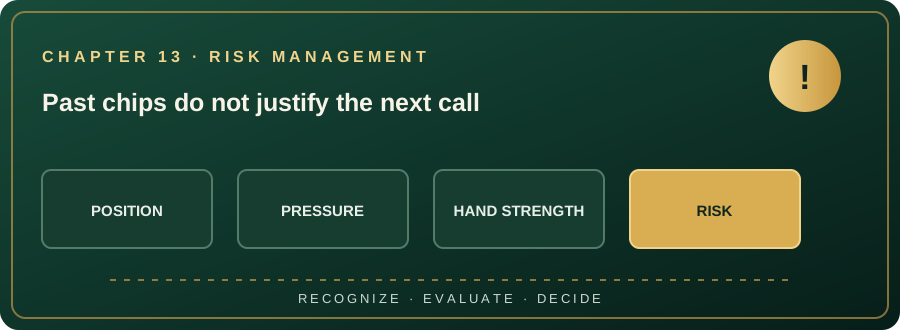
One form of poor risk management is committing a large portion of a stack with a marginal hand. Another is calling a bet without comparing the price to the pot and the chance of winning. In both cases, the player focuses on wanting to continue rather than on whether continuing is justified.
Look beyond the obvious
Pot odds provide one useful comparison: the amount you must call relative to the pot you could win. Expected value broadens the question by considering the possible outcomes and their probabilities. These concepts do not remove uncertainty, but they help make the cost of a decision visible.
A more disciplined approach
Tournament risk has additional consequences. Losing a large portion of your stack can reduce future options, and elimination ends your opportunity to continue. That does not mean you should play timidly; it means stack size and tournament circumstances belong in the decision.
Put the idea into practice
Review a large losing pot. Was the risk reasonable based on what you knew at the time, or did the size of your previous investment pull you into a decision you would otherwise avoid?
Identify the obstacle, evaluate the situation with the information available, and choose a deliberate response rather than reacting automatically.
Watch Video 13: The Problems Created by Poor Risk Management
If the video does not load, watch Video 13 on YouTube.
Ready for the complete book?
This online edition introduces the framework and selected ideas. The complete book develops the concepts in greater depth.
Buy the Complete Book on Amazon