The challenge
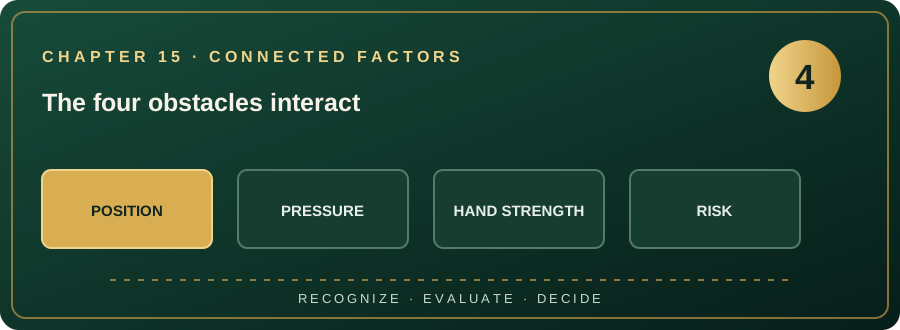
The four obstacles are most useful when considered together. Position affects how much information you receive. That information helps you interpret pressure. Pressure and board texture influence how you evaluate hand strength. Hand strength, pot size, and stack depth all affect the risk of continuing.
Look beyond the obvious
Imagine holding a medium-strength hand in late position. Several opponents check, and you face a modest bet from one player. Your position gives you information about the action; the bet creates pressure; the board determines how your hand compares with possible holdings; and the pot odds help measure the risk. No single factor tells the whole story.
A more disciplined approach
Sometimes one obstacle is clearly dominant. In other situations, two or more combine to make a decision difficult. A strong hand can still face unacceptable risk against a very narrow, powerful range. A favorable price can still be unattractive when your draw is unlikely to be best if it completes.
Put the idea into practice
Practice describing a decision through all four lenses. This prevents you from allowing one appealing feature—such as a strong starting hand or late position—to obscure the rest of the situation.
Identify the obstacle, evaluate the situation with the information available, and choose a deliberate response rather than reacting automatically.
Watch Video 15: How the Four Obstacles Interact
If the video does not load, watch Video 15 on YouTube.
Ready for the complete book?
This online edition introduces the framework and selected ideas. The complete book develops the concepts in greater depth.
Buy the Complete Book on Amazon