The challenge
Many decisions improve when you pause long enough to identify the central problem. The pause need not be long. It is a deliberate interruption of automatic play: notice the action, identify the obstacle, and then choose a response.
Look beyond the obvious
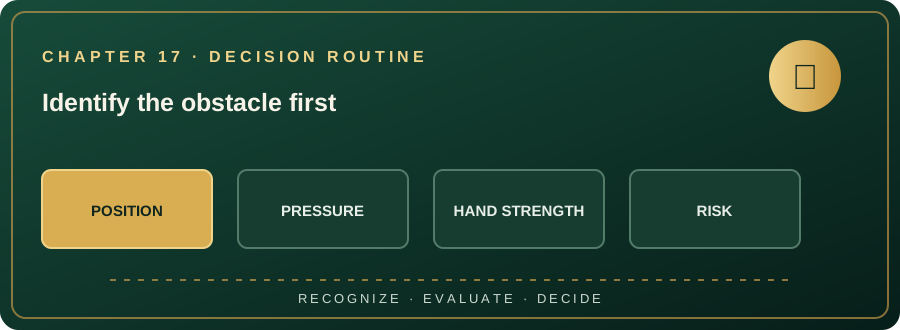
Ask four questions. Position: who acts after me, and what information do I have? Pressure: what does this bet or raise demand, and what might it represent? Hand strength: how does my holding compare with the board and likely opponent hands? Risk: what am I investing, and what can I reasonably win?
A more disciplined approach
One question may reveal the key issue. If you are out of position against several opponents, position may dominate. If a large river bet arrives on a completed draw-heavy board, pressure and hand strength may matter most. If the call is for most of your stack, risk deserves special attention.
Put the idea into practice
The framework is a guide, not a rigid ritual. With practice, the questions become quicker and more natural. The purpose is to make the important factor visible before chips go into the pot.
Identify the obstacle, evaluate the situation with the information available, and choose a deliberate response rather than reacting automatically.
Watch Video 17: Recognizing the Obstacle Before Making the Decision
If the video does not load, watch Video 17 on YouTube.
Ready for the complete book?
This online edition introduces the framework and selected ideas. The complete book develops the concepts in greater depth.
Buy the Complete Book on Amazon