The challenge
Folding too often gives opponents an incentive to bet into you. Calling too often creates a different problem: you pay to continue without a clear plan for later streets. Raising without a reason can inflate the pot against hands that are not likely to fold or against opponents whose ranges are stronger than you assumed.
Look beyond the obvious
Pressure also becomes difficult when players focus on the size of the wager rather than the whole situation. A large bet can be intimidating, but its meaning depends on the pot, the board, the opponent, and the story told by previous actions. A small bet can still create a serious decision if it is part of a larger plan.
A more disciplined approach
Emotional reactions make these errors worse. Frustration after a bad beat can lead to a call that is really an attempt to win back chips. Fear of being bluffed can lead to defending a hand that has little chance to improve.
Put the idea into practice
Review a hand in which you felt forced to act. Separate the emotional discomfort from the strategic facts. What did the bet represent, and what price were you being offered?
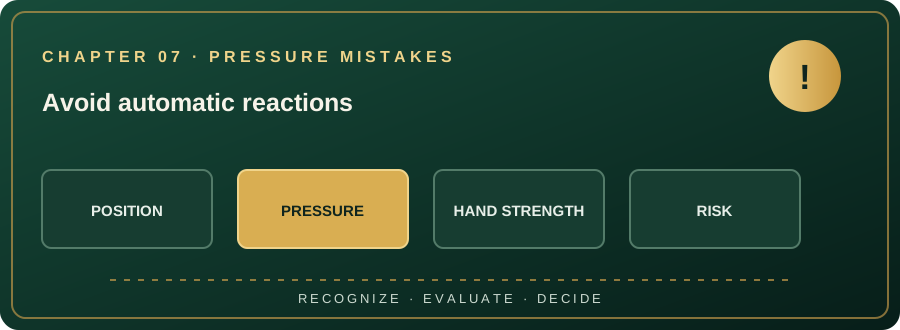
Identify the obstacle, evaluate the situation with the information available, and choose a deliberate response rather than reacting automatically.
Watch Video 7: The Problems Created by Poor Pressure Management
If the video does not load, watch Video 7 on YouTube.
Ready for the complete book?
This online edition introduces the framework and selected ideas. The complete book develops the concepts in greater depth.
Buy the Complete Book on Amazon